









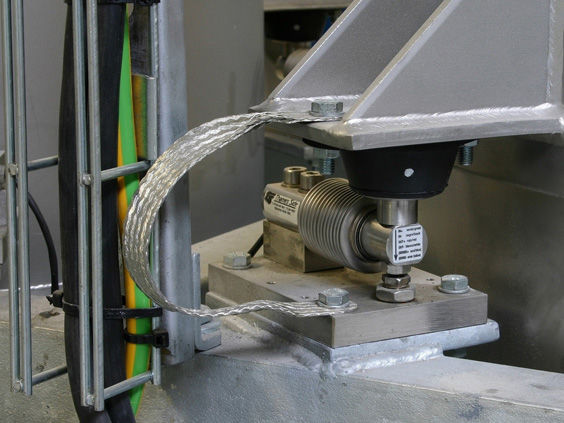
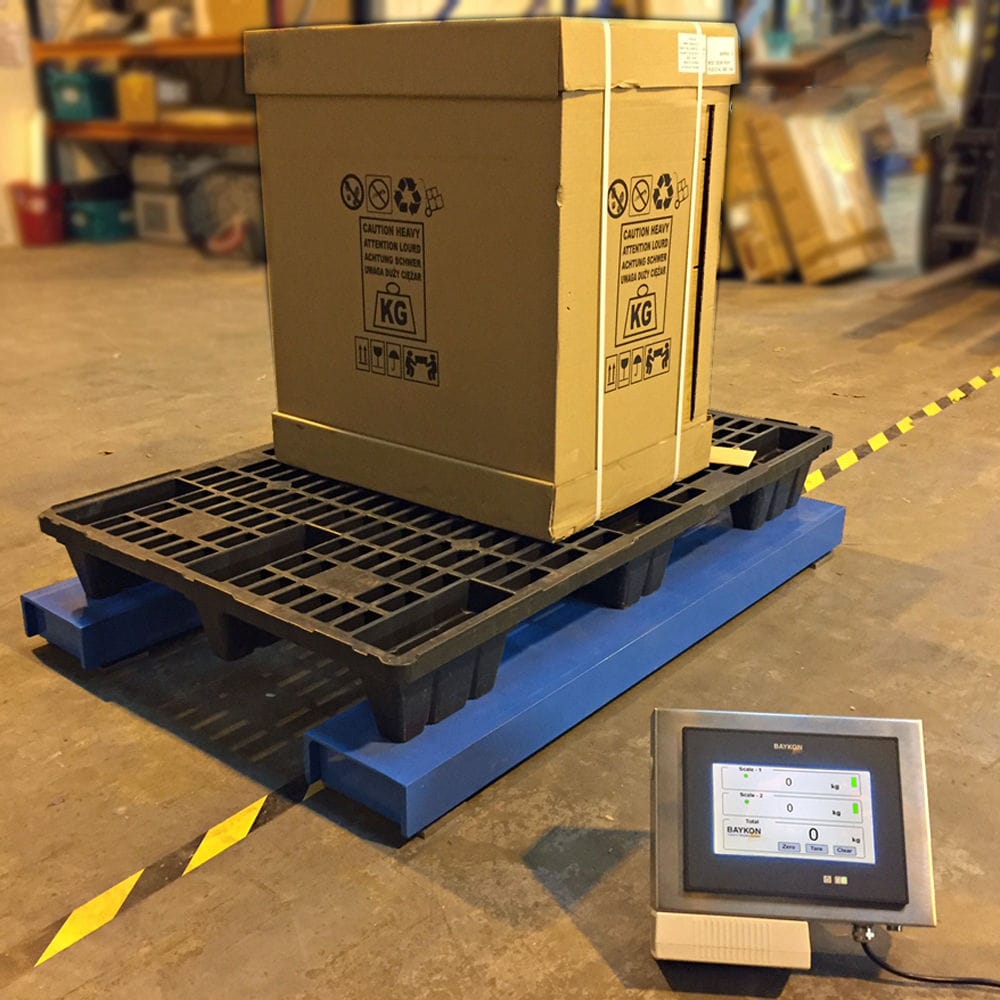


The wireless weighing fork is equipped with a weighing console on the electric forklift, and the weighing instrument is installed on the console. The data lines installed with weighing sensors at the lower parts of the two fork support legs are connected with the digital instrument. When the elastic body adopting digital weighing is subjected to force from the stress direction (such as the gravity of goods), the elastic body generates corresponding micro deformation, which is transmitted to the digital weighing instrument through the force transmission mechanism, and the gravity signal output by the sensor is amplified and filtered. It is sent to an A/D converter to be converted into a digital signal, and the microprocessor calculates the weight value according to the mechanical mathematical model. When the forklift mast is in a vertical state, the weighing data is prompted to be read, and the digital weighing LED displays the results. The real-time data is uploaded to the computer control room by the weighing instrument through wireless.


 020-34563445
Electric forklift Electronic scale refers to various wheeled handling vehicles used for loading, unloading, weighing, stacking, and short distance transportation of palletized goods. The International Organization for Standardization ISO/TC110 refers to electronic scales as industrial vehicles. Belongs to material handling and weighing machinery. Widely used in various sectors of the national economy such as stations, ports, airports, factories, and warehouses, it is an efficient electronic weighing equipment for mechanized loading and unloading, measurement, stacking, and short distance transportation. Forklift electronic scale is a widely used lifting, loading, unloading, and transportation weighing machinery, widely used in ports, docks, warehouses, freight yards, and industrial and mining enterprises for loading, unloading, stacking, weighing, and short distance transportation of bulk goods. Forklift electronic scale is a new type of electronic weighing technology developed by integrating modern microelectronics technology and microcomputer technology. The sensor body is composed of four weighing elastic bodies on the base, and the strain gauges attached to it undergo slight deformation. The deformation of the strain gauges leads to changes in their resistance. In order to measure the changes in resistance, the weighing sensors are connected into a bridge circuit. When there is no external force acting on the sensor, the bridge achieves balance; When the sensor is subjected to external force, the voltage at the CD terminal is not equal. The voltage change is measured by an amplification circuit and converted into the corresponding mass value for display.
In order to ensure measurement accuracy in various environments for forklift weighing, linear compensation, zero point compensation, temperature compensation, and anti-corrosion treatment of sensor surfaces are generally added to the strain gauge bridge of forklift weighing. At the same time, to ensure the accuracy of remote excitation of the sensor, two wires are generally output from the excitation ends of the strain gauge to the weight transmitter or weighing terminal for calculating the loss compensation of the excitation voltage during long-distance transmission. The forklift electronic scale adopts a sealed junction box, which is dustproof and moisture-proof, ensuring reliable signal transmission. The weighing instrument adopts a dedicated industrial process control instrument, which communicates with the central control room through RS-485 bus, and can be independently controlled or PLC online controlled. Composed of a computer, weighing module, and peripheral devices, it serves as the human-machine interface of the entire system. Complete all system parameter settings, process monitoring, and data recording.
The forklift weighing device includes a front hanging plate, a rear hanging plate, and a weighing module. The front hanging plate and the rear hanging plate are steel plates with a thickness of 2cm. The weighing module is an S-shaped pull weighing module. The upper and lower ends of the front hanging plate are respectively equipped with four bearings, which are needle roller bearing shafts. The four bearings are fitted on one shaft, and the shaft is fitted with a fixing block. The fixing block is interference fit with the bearing and the shaft during assembly. The fixing block is fixedly connected to the front hanging plate with bolts; The upper and lower ends of the rear hanging plate are fixedly installed with four bearing guide rails. The bearing guide rails are square frame structures, and the tail end of the frame is fixedly connected to the rear hanging plate bolts. The four bearing guide rails are arranged side by side, and their material is alloy steel. The inner surface of the bearing contact surface is quenched and then precision machined to make the surface flat, with a surface hardness of 55HRC. Circular bearings are installed inside the bearing guide rails through shafts and fixed blocks. Four limit blocks are fixedly installed on the middle edge of the front hanging plate 1. The limit blocks are steel plates bolted to the front hanging plate body. Four limit bearings that match the limit blocks are installed on the middle edge of the rear hanging plate, which are bolt bearings. The rear hanging plate is threaded, and after installation, the limit blocks are located outside the corresponding limit bearings.
The top and bottom of the weighing module hanging plate have protruding plate slots, which are used to cooperate with the protruding teeth and grooves on the lower part of the forklift door frame for installation. During use, two weighing devices are installed on the forklift door frame, and then the two fork teeth of the forklift are respectively clamped onto the weighing device of this utility model. The vehicle weighing device, tension and pressure transmission device, data display device, and printing device constitute the vehicle Weighing system. The weighing module of the vehicle weighing device is connected to the data line of the tension and pressure transmission device. The tension and pressure transmission device consists of a tension and pressure transmitter, a Bluetooth module, and a battery. It is installed on the outside of the forklift weighing device and is connected to the data display device via Bluetooth. The data display device is connected to the printing device via a data cable. The data display device and printing device are fixedly installed on the forklift cab bracket. When the weighing module is working, attach two weighing devices to the forklift frame, and then attach the gear to the front hanging plate of the weighing device. Check if the installation is correct, then start the vehicle, insert the gear into the tray loaded with heavy objects, lift the gear, and the weight of the goods can be read. When printing is needed, print the weighing result.
Technical parameters
Maximum weighing: 2000kg, 3000kg, 5000kg
Minimum weighing: 1kg, 2kg, 2kg
Accuracy: ± 0,1%
Measurement section: Electronic scale display instrument and sensor
Power supply: 6-digit LED display
Selection: Electric forklift dedicated printer (RS-232C)


