









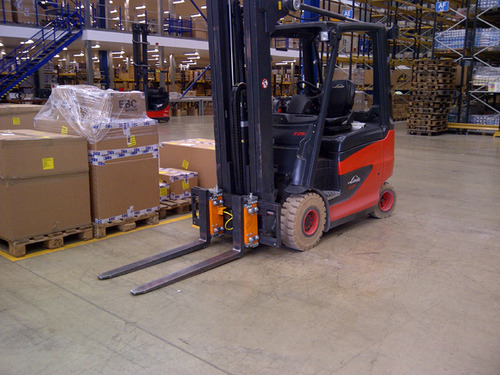
The hazardous waste forklift weighing system is a dedicated on-board weighing system designed for mobile forklifts. It adopts a unique design structure of attaching a weighing plate. The original teeth of the forklift are removed, and the weighing plate assembly is hung on the forklift's fork frame. Then, the teeth are suspended on the scale body. This weighing system is easy to install and does not require mechanical or hydraulic modifications. It is safe and reliable. The weighing system uses a static method to weigh the loaded goods. The hazardous waste weighing terminal not only displays the weight but also can set pre-set points to achieve the purpose of overloading alarm and prompt.

 020-34563445
The hazardous waste forklift Electronic scale refers to various wheeled handling vehicles used for loading, unloading, weighing, stacking and short-distance transportation of packaged palletized goods. The International Organization for Standardization ISO/TC110 calls it an industrial vehicle for electronic scales. It belongs to the material handling weighing machinery. The forklift weighing can be installed on almost all forklifts' crossbars, weighing the goods while transporting them. The wireless hazardous waste weighing instrument uses Bluetooth technology to view and track the weight of individual goods and the total weight of multiple goods in real time. As a high-precision dynamic real-time measurement and handling equipment, it is used for inventory control, preventing overload, batching, waste management, picking and inventory management. To ensure the measurement accuracy in various environments of forklift weighing, linear compensation, zero point compensation and temperature compensation treatments are generally added to the strain gauge bridge circuit of forklift weighing, as well as anti-corrosion treatment of the sensor surface. At the same time, to ensure the accuracy when the sensor is remotely excited, two wires are generally output from the two ends of the strain gauge to the weight transmitter or weighing terminal to calculate the loss compensation of the excitation voltage during long-distance transmission. Replacing or adjusting digital weighing sensors and digital weighing instruments can be directly adjusted on the weighing instrument, without adjusting the angle difference through the junction box, greatly improving the convenience of regular weighing detection and the simplicity of maintenance.
The hazardous waste forklift scale refers to various wheeled handling vehicles used for loading, unloading, stacking and short-distance transportation of packaged palletized goods. During the transfer process, it is often necessary to measure the net weight or gross weight of the goods. The common practice is to use a forklift to transport the items to a platform scale or weighbridge for weighing, then transfer them to the designated location. This process is time-consuming and labor-intensive, with low efficiency. The forklift scale is a vehicle-mounted Weighing system specifically designed for mobile forklifts. The system has a simple structure, mainly consisting of a mounting plate component with a weighing sensor, a hazardous waste weighing terminal, cables, etc. The weighing system adopts the unique design structure of plate weighing, removing the original teeth of the forklift and hanging the weighing plate assembly on the forklift fork frame, then suspending the teeth on the scale body. This weighing system is easy to install and does not require mechanical or hydraulic modifications. It is safe and reliable. The weighing system uses a static method to weigh the loaded goods. The hazardous waste weighing terminal not only displays the weight but can also set pre-set points to achieve the purpose of overload alarm and prompt.
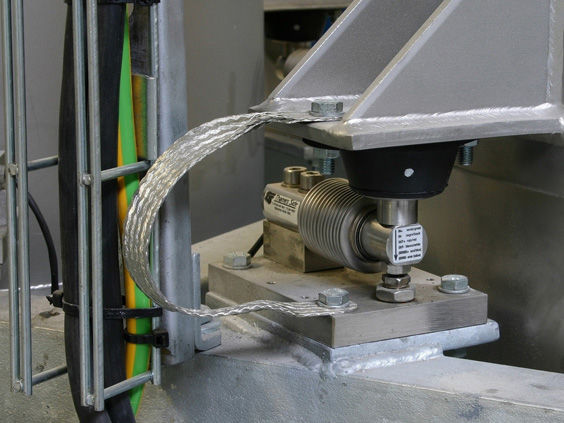
The hazardous waste forklift scale adopts a front frame, a rear frame, a pull-type weighing sensor, and multiple fixing devices. The front frame and the rear frame are fixedly connected through multiple fixing devices. One end of the pull-type weighing sensor is fixedly connected to the front frame, and the other end is fixedly connected to the rear frame. The fixing devices include spring plates and multiple fasteners. The spring plate is fixedly connected to the front frame and the rear frame through multiple fasteners. The fixing devices have more than six groups, and they are respectively fixedly connected to the upper and lower parts of the front frame and the rear frame. The pull-type weighing sensor has two. The upper part of the rear frame has an upper hanging plate, and the lower part has a lower hanging plate, which is convenient for installing on the crossbeam of the forklift's door frame. The front frame has a fork hanging groove, which is convenient for installing the forks. One end of each weighing sensor is respectively connected to the junction box, and the output end of the junction box is connected to the spiral signal cable and the hazardous waste weighing terminal. The hazardous waste weighing terminal can be installed on the forklift. When the weighing sensor receives the load, it converts and processes the weight signal through the measurement circuit to obtain the measurement result. The signal processing can be handled and displayed by the hazardous waste weighing terminal. The cable passes through the lifting ring, ensuring that the forks and the rear frame are in a state where the spiral cable end is not under force during the up and down movement of the forks and the rear frame; when the forks lift the goods, the crossbeam remains perpendicular to the ground, and the goods are placed as much as possible at the rear end, which is close to the front frame. At this time, the forks are under force, that is, the front frame is under force. The front frame vertically shifts downward and transmits the force to the weighing sensor, which converts the analog signal through the junction box signal aggregation and transmits it through the spiral cable to the hazardous waste weighing terminal. After being processed by the hazardous waste weighing terminal, the signal is displayed.


