







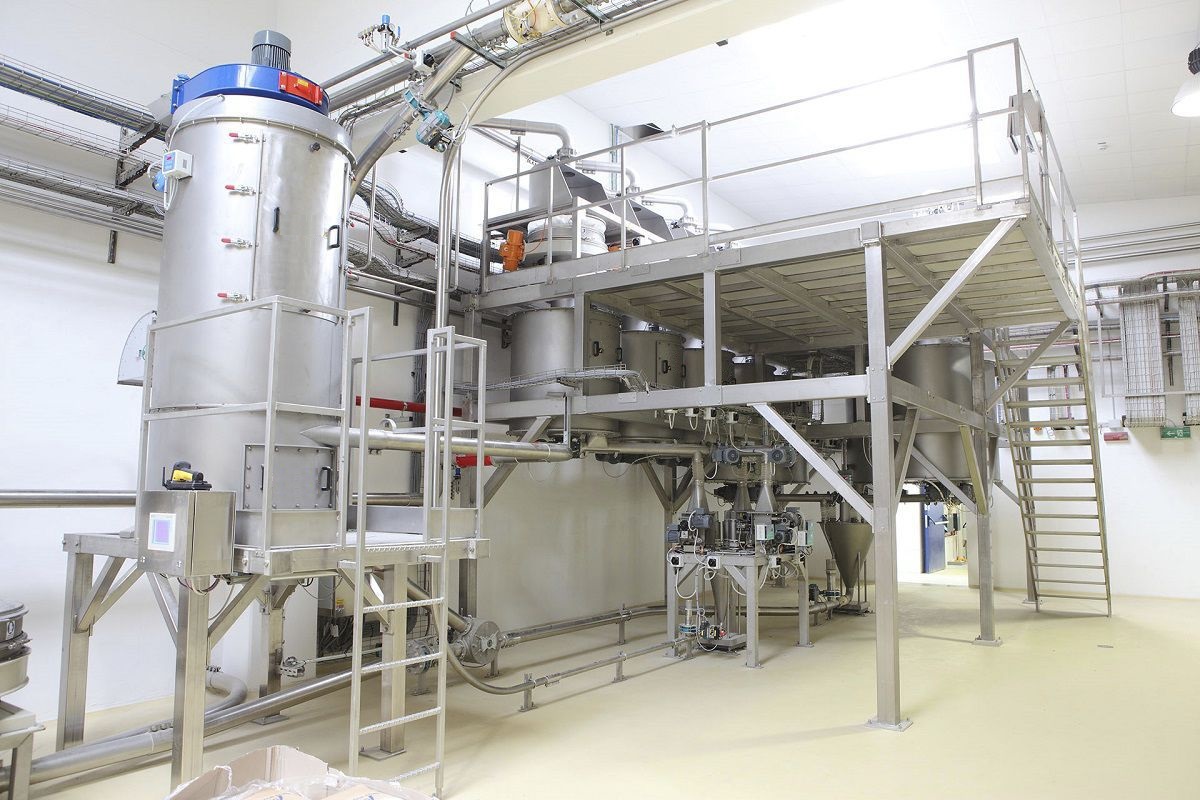
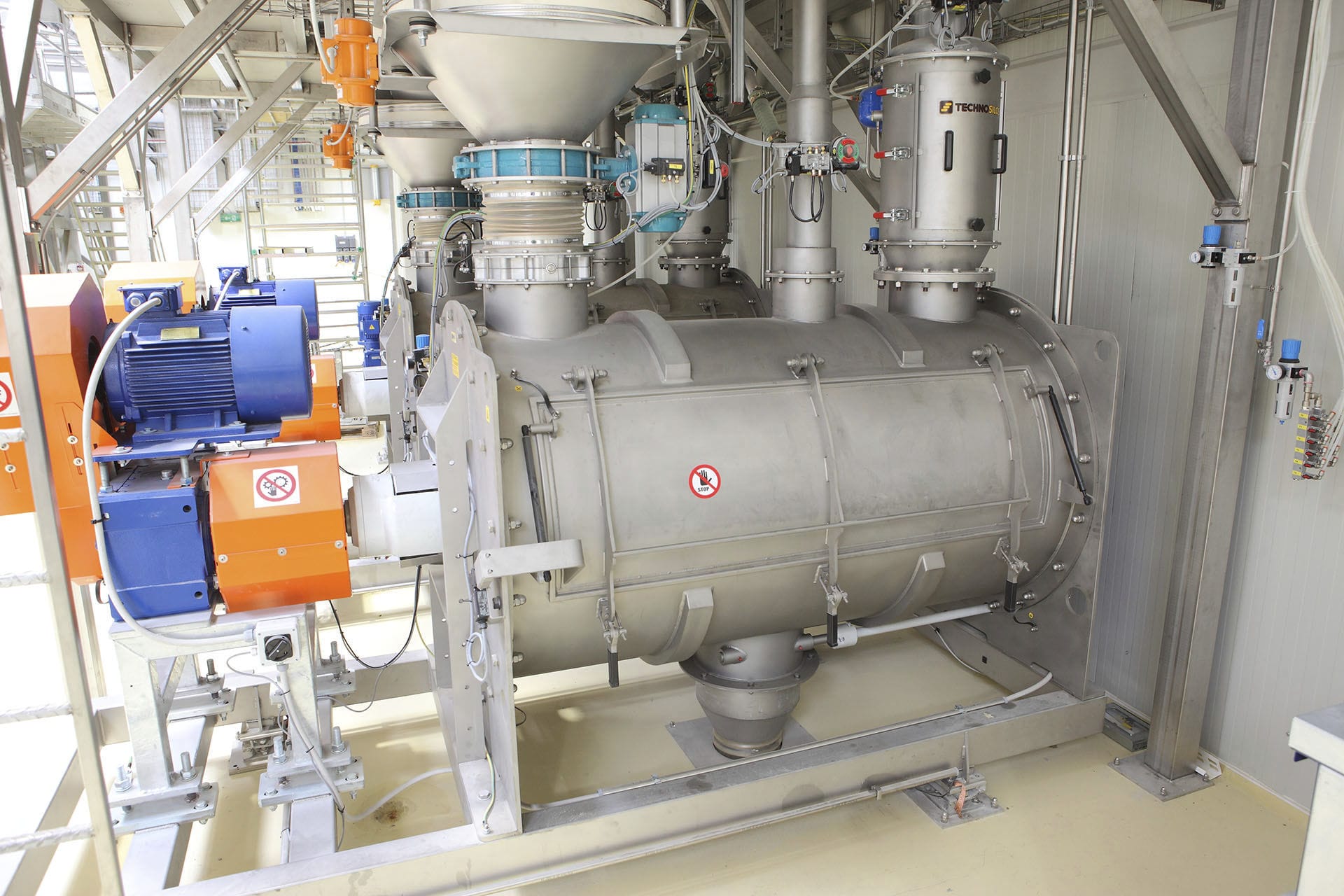


The mixing and feeding equipment adopts the regulating valve or changes the pressure of the issuing tank for dosage, and PID adjusts the weight value to the pressure of the dosage tank or the opening of the regulating valve. The standard proportional function and the proportional calculation of the weighing system are used to ensure the stability of the weighing performance. The given value is multiplied by a multiplier to calculate the target value of the dosage weight, which is given remotely as a control quantity, and the reciprocal is taken to calculate the weight of the discharged material by a multiplier, thus realizing interactive dosage.

 020-34563445
The weighing, stirring and feeding equipment is a complex construction device, and the production environment is extremely harsh. Currently, most of the control Batching systems of reaction vessels mostly adopt the mode of upper-level monitoring +PLC, or upper-level monitoring +PLC+ weighing instrument. To ensure the reliability of the entire control batching system, Advantech industrial control computers are selected as the upper computer. They are equipped with analog data acquisition boards to collect various sensor signals from production weighing. Digital acquisition boards are used as input signals for detection and control output. Through the weighing module of the reaction vessel, the entire process control from batching, unloading, stirring, discharging to recording is achieved. The analog signal acquisition adopts Advantech PCI bus isolated high-speed analog input card. The input and output of status signals adopt Advantech PCI bus isolated digital I/ O card. The batching monitoring and management software collects on-site signals at high speed through the computer for automatic control, and automatically and precisely configors various materials according to the pre-set scheme. It features dynamic monitoring, real-time alarm and error correction functions to ensure the stability of product quality. Meanwhile, this ingredient system also provides background data management functions, including user management, formula management, report management, weighing calibration and other functions.
The stirring and feeding system uses regulating valves or changes the pressure of the batching tank for batching, and the weight value is adjusted by PID to regulate the pressure of the batching tank or the opening degree of the regulating valve. The standard proportional function and the proportional calculation of the Weighing system are adopted to ensure the stability of the weighing performance. The given value is calculated by the multiplier to determine the target value of the ingredient weight, which is used as the remote setting of the control quantity. After taking the reciprocal, the ingredient weight is calculated by the multiplier, thereby achieving interactive ingredient mixing. The simultaneous feeding system has the following functions:
Control measures for accuracy and efficiency
In software design, various aspects such as reliability, weighing calibration, weighing accuracy, and data processing are comprehensively considered to enhance production efficiency and control accuracy.
Digital filtering
In the input of weighing analog signals, due to the influence of mechanical vibration, electrical interference, etc., the signal distortion is relatively serious. The software first filters the sampled data signals, eliminates and suppresses the interference signals, and adopts the drop tracking adjustment. During the production process, it can be automatically corrected. This can ensure that the powder material error is within ±2%, while the error of other powder materials is within ±1%. Through the pre-processing of data, the weighing terminal can weigh materials in advance during continuous production to improve efficiency. When weighing, it first feeds materials at high speed. After reaching about 90% of the set value, it starts to shake and replenish materials to achieve precise weighing.
Weighing calibration
The rough adjustment of weighing calibration is accomplished by hardware, while the fine adjustment is carried out by software, to avoid the problem of zero point migration and mutual restraint of gain amplitude in the hardware circuit during the fine adjustment of weighing calibration, and to improve the calibration efficiency and accuracy of explosion-proof Electronic scales.
Automatic zero adjustment
Since the weighing substance may stick to the weighing hopper and affect the weighing accuracy, the method of automatically adjusting the zero point by software is adopted to eliminate the influence of weighing viscous substances on the accuracy of repeated weighing.
Drop correction
The batching process is a dynamic weighing process, and the weighed substances fall freely onto the weighing hopper. When the weighing value is reached, the randomness of the regional difference caused by the discreteness of mechanical action delay affects the accuracy of dynamic weighing.