









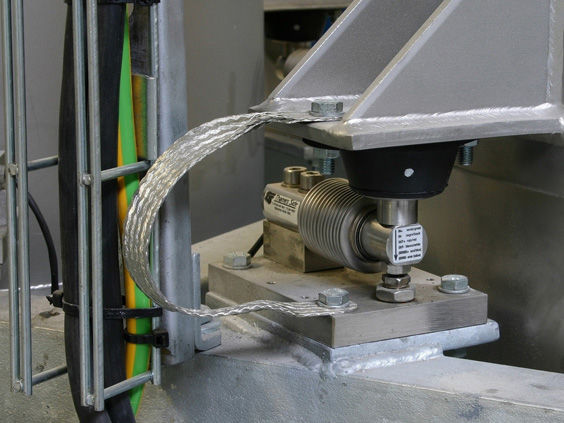




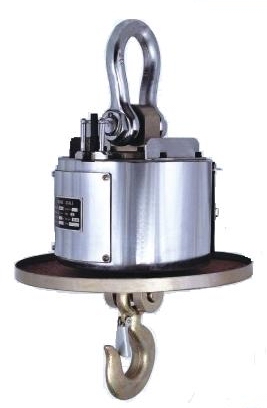
Wireless electronic crane scale is a relatively advanced crane scale which transmits the weighing data to the ground display by radio, which greatly facilitates the use of electronic crane scale, and at the same time, it can easily print, store, and transmit the weighing results to the computer or big screen. It mainly includes wireless instrument, upper hanging ring, lower hook, receiving and transmitting protective seat, receiving and transmitting device, AD box, AD converter, sensor, antenna, battery and other main components. It fundamentally realizes the separation of weighing body and display, and transmits the data after weighing body load bearing to the display through radio, which is convenient for printing and storing data.

 020-34563445
The wireless electronic hanging scale transmits the weighing data to the ground display by radio, which greatly facilitates the use of the electronic hanging scale, and can also conveniently print, store and transmit the weighing results to a computer or a big screen. It is a relatively advanced hanging hook scale. It mainly includes wireless instrument, upper lifting ring, lower hook, receiving and transmitting protection seat, receiving and transmitting device, AD box, AD converter, sensor, antenna, battery and other main components. The separation between the scale and the display is fundamentally realized, and the data after the scale is loaded is transmitted to the display by radio, which is convenient for printing and storing data.
The weighing of electronic hanging scale is a dynamic process, and the dynamic weighing accuracy is closely related to every link in the control process. It is necessary to judge and detect the quality of the weighed material in a short time, adjust the weight of the material through algorithmic operation control, correct the measurement error due to air shaking, replace it with compensated output, and the compensation transfer function is constantly changing. According to increasing the damping ratio of the system to the ideal Weighing system, the dynamic value is output. In the weighing process, the system should always be kept as the best second-order system, and the application link should dynamically compensate the system. When the zero-pole of the transfer function of the weighing system changes due to the dynamic change of the material weight, the adaptive dynamic compensator will constantly change its own pole, adjust its own zero-point with the dynamic of the weighing system, and cancel out the poles of the weighing system, and the system with series adaptive dynamic compensation link will always be kept as the best second-order system, so as to achieve the effect of adaptive dynamic compensation.
On the dynamic longitudinal axis of the electronic hanging scale, two accelerometers are installed at the upper and lower ends. The sensitive axes of the accelerometers are strictly coincident with the axis of the hanging scale, and the lateral sensitivity is zero, that is, the output of the accelerometers is only related to the magnitude of the acceleration component in the axis direction of the hanging scale. If the length from the hanging scale to the center of the weight is known, the acceleration value of the weight along the sling direction can be calculated by using a group of measured values of two accelerometers at the same moment, so that the compensation calculation of dynamic weighing can be completed in an instant. When the length of the sling is unknown, the compensation calculation can be completed by two groups of measured values at intervals. The intermediate circuit of the weighing system simulates and filters the impact signal of the measured material, other pulse interference signals and various electrical interferences from inside and outside the system, which cannot completely eliminate these interference signals, especially the interference signals with lower frequency. Interference signals that can't be completely eliminated will also be mixed with some new interferences after filtering. In addition, the accuracy of A/D and A/D converters and the influence of circuits are extremely unfavorable to the weighing accuracy of the scale. These interferences can be eliminated through digital filtering. The digital filter calculates each frequency, and when the frequency characteristic is close to the given frequency characteristic, it removes the interference and extracts the useful signal, so as to eliminate the interference.
The electronic hanging scale is hung on the hook of the lifting machine through the lifting ring, and the weighed weight is hung on the hanging scale hook through the sling. The weighing sensor can measure the tension of the sling and output it in the form of voltage analog. The lower accelerometer and the upper accelerometer, which are fixed at a fixed distance on the axis of the hanging scale, respectively measure two components of gravity acceleration along the sling direction and the composite acceleration component of centripetal acceleration and output them in the form of voltage analog, and the A/D converter respectively converts the voltage analog output by the weighing sensor and the two accelerometers into digital quantities and transmits them to the weighing motherboard. The main board of weighing instrument converts these digital quantities into serial signals, and calculates the mass of heavy objects through mathematical processing of wireless transmitter, which can be displayed by weighing instrument, printed by printer or transmitted to upper computer through data interface, and compensates the data needed for calculation through keyboard weighing control instrument working state or input sling length.
Intuitively, the two accelerometers and the center of mass of the weight should be on the same axis and the distance is fixed, that is, they form a "rigid body". No matter how complicated the motion of this "rigid body" is, every moment can be regarded as a combination of translation of the "rigid body" and rotation around the instantaneous rotation center on the axis. The acceleration of each point along the axis can be decomposed into two parts: the sum of the component of gravity acceleration along the axis and the translational acceleration of a "rigid body" along the axis, and the centripetal acceleration around which the point rotates. For the former, the three values are the same, and the latter changes linearly along the axis, so the acceleration along the axis at the center of mass of the weight can be calculated from the measured data of two accelerometers, thus completing the compensation operation of dynamic weighing.


