






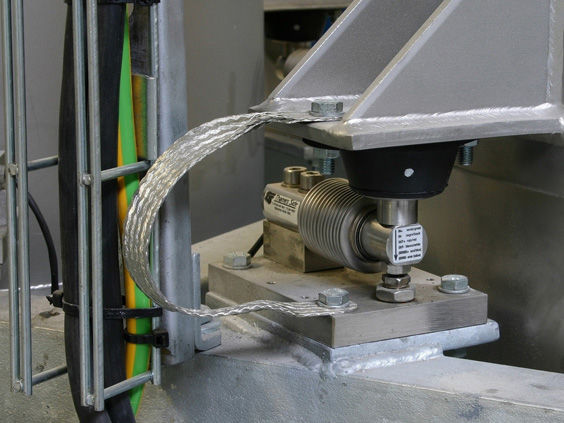


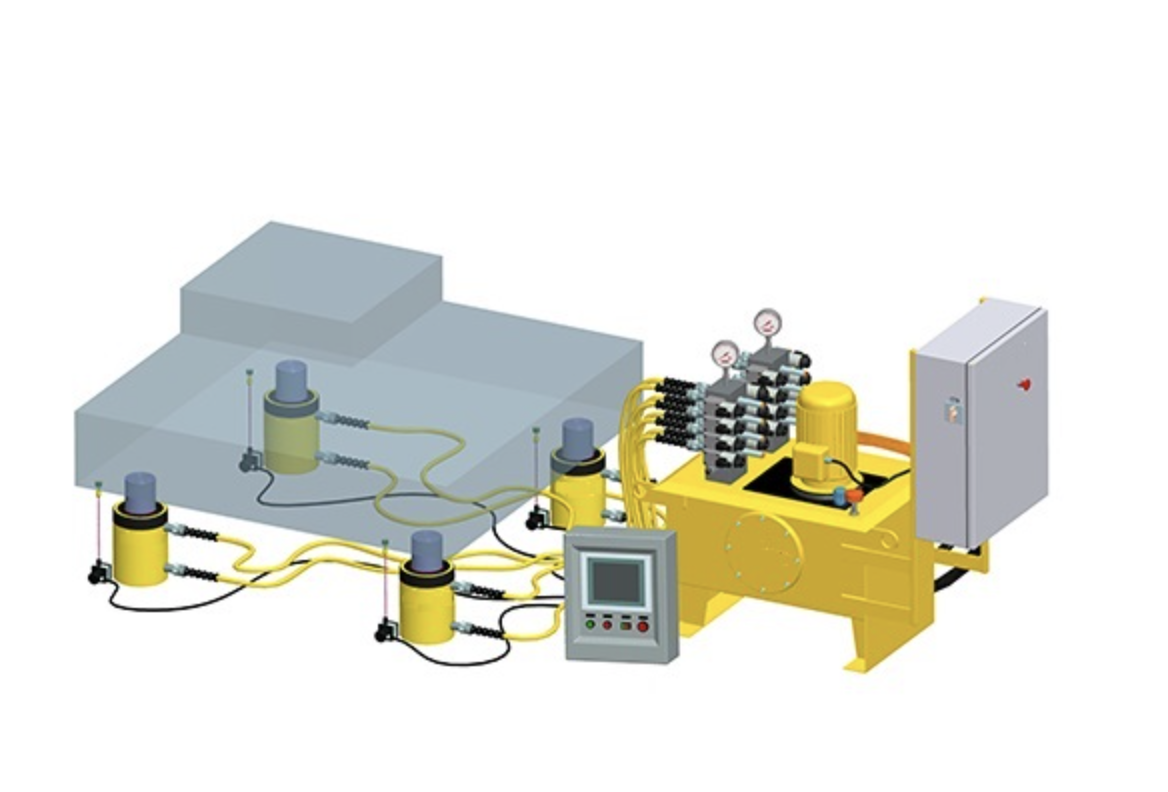
The lifting system of the weighbridge scale adopts a large-scale structure and realizes the lifting through the simultaneous lifting of multiple hydraulic jacks. The bearing capacity of the hydraulic jacks is collected by the weighing sensor, and the displacement value of the pile leg is collected by the displacement sensor. The platform is lifted to a certain distance to achieve this. The entire weight of the platform is supported by the hydraulic cylinders of the hydraulic jacks. The weight of each hydraulic cylinder is measured accurately, and multiplied by the working area of all the hydraulic cylinders to obtain the weight of the platform. The center of gravity position coordinate parameters of the structure can be obtained based on the coordinates of the hydraulic jacks.

 020-34563445
The scale platform adopts a large-scale structure and achieves synchronous lifting through multiple hydraulic jacks. The bearing capacity of the hydraulic jacks is collected by the weighing sensor, and the displacement value of the pile leg is collected by the displacement sensor. The platform is lifted to a certain distance to achieve this. The entire weight of the platform is supported by the hydraulic oil cylinders of the jacks. The weight of the platform is obtained by weighing the hydraulic oil of each jack with accurate measurement and multiplying it by the working area of all the hydraulic cylinders. The center of gravity position coordinates parameters of the structure can be obtained based on the coordinates of the hydraulic jacks. A self-locking PLC hydraulic synchronous control system is adopted. The hydraulic jacks are precisely lifted the platform according to the actual load of the upper structure on the platform, ensuring that the additional internal force on the beam during the lifting process is minimized. The hydraulic jacks are grouped according to their distribution positions and form a position closed-loop with the corresponding displacement sensors (gratings) to control the displacement during the lifting process and the posture of the beam during the lifting. The synchronization accuracy is +1.0mm. This can ensure the synchronization of the lifting process and the safety of the beam structure during the lifting.
The scale uses a hydraulic system that is integrated within the large structure of the scale and moves synchronously to lift the top of the scale platform along with multiple jacks, ensuring that the scale platform and the jacks all lift to the same horizontal plane on the scale platform. Based on the position of the scale weighing sensor, the number of built-in synchronous jacks is determined. Once all the structures have completely left the scale surface and stabilized, the pipeline oil pressure is measured by the weighing sensor, thereby achieving high-precision weight measurement. This method has a short measurement time and high accuracy. In the hydraulic system, multiple hydraulic cylinders need to be controlled to work collaboratively. The lift height of each pile leg is detected using a displacement sensor, and the bearing condition of each jack is detected using the weighing sensor. Using advanced data bus technology, the information of equipment such as the weighing sensor, displacement sensor, status setting switch, oil pump directional valve, and high-pressure electromagnetic valve is converted by A/D and sent to the manual control computer. The computer processes the collected signals and makes judgments, then sends corresponding control instructions to the I/O output circuit. Solid relays are used to control the electromagnetic valve for the drive circuit, thereby achieving computer-synchronized lifting control of the hydraulic system.
The weighing sensor detection device of the scale mainly aims to obtain the position information of the lifting cylinder, the load information, the tightness of the upper and lower anchorages, and the aerial posture information of the entire lifted component, and then transmit these information through the on-site real-time network to the main control computer. The main control computer can determine the synchronous action of the lifting cylinder or the next step action based on the current oil cylinder position information received from the network. At the same time, the main control computer can also determine the synchronous adjustment amount of the entire system based on the lifting load information and the posture information of the component received from the network. The main control computer judges the safety and reliability of the lifting process based on various detection signals. When problems occur during the lifting process, it issues a safety alarm and automatically stops the lifting operation. In the lifting system, a main lifting height is set first. The heights of other lifting heights are compared with the height of the main lifting height. Laser distance meters for measuring each height are arranged under each lifting height, which can timely feed back the height of each following lifting height to the main control computer. The main control computer determines the control quantity of the corresponding proportional valve according to the height difference of each point and follows a certain control algorithm to decide the corresponding speed or action of each lifting cylinder, thereby balancing the lifting speed or action of each cylinder and achieving the synchronization of the position of each following lifting height with the main lifting height.
The Electronic scale is powered by hydraulic jacks. According to the lifting force requirements at each operation point, several hydraulic jacks are combined with hydraulic valve groups, pump stations, etc. into a hydraulic jack cluster, and they move synchronously under the control of a computer to automatically complete various functions such as synchronous lifting, load balance, posture correction, stress control, operation locking, process display, and fault alarm, ensuring the stability of the posture of large structures during the lifting or shifting process. The electronic scale's computer-controlled hydraulic synchronous lifting system consists of steel cables and lifting cylinder clusters (load-bearing components), hydraulic pump stations (driving components), and sensing detection and computer control (control components). The hydraulic synchronous lifting technology expands and combines the lifting equipment through extension, and the lifting weight, span, and area are not limited. The lifting cylinder anchors have self-locking properties in reverse motion, making the lifting process very safe, and the components can be reliably locked at any position during the lifting process for a long time. The lifting system has a micrometer-level fine-tuning function and can achieve precise vertical positioning in the air.


