


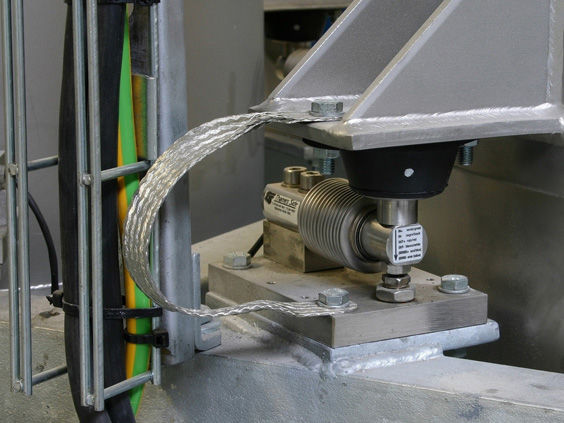
The rotary table ladle electronic scale is equipped with weighing modules installed on the fork of each ladle arm by spherical thrust bearings. It adopts a high-temperature resistant fully welded sealed column structure and can work reliably at a high temperature of 180℃. It is used to receive ladles and display their weight. High-strength sleeves are adopted for guidance and buffering. The connecting ears are vertical limit devices to prevent the load-bearing beams from lifting or jumping. The air-cooling system cools the weighing module, extending its working time in high-temperature environments. To keep the molten steel warm, compressed air is used to cool and reduce the temperature of the load cell, so as to meet the requirements for the load cell to work in a high-temperature environment for a long time.
020-34563445The rotary table ladle Electronic scale is a rotating device in the casting area of the continuous casting machine. It rotates the pre-treated ladle molten steel from the receiving position to the pouring position to prepare for pouring. At the same time, the empty ladle that has been filled with molten steel is rotated to the receiving position, ready for transportation away, thereby achieving multi-furnace continuous casting. The working conditions of the ladle electronic scale are harsh and it has a large load capacity. It must withstand the impact of the ladle release, as well as the radiation and splashing of the molten steel. Slab continuous casting has very high requirements for the quality of molten steel. To prevent the secondary oxidation of molten steel and achieve closed casting, the continuous casting process requires that the ladle electronic scale has functions such as load-bearing, rotation, lifting, weighing, heat preservation and positioning. The turntable adopts hydraulic independent lifting, which is convenient for installing the long water outlet and realizes the casting without oxidation protection. It is equipped with an automatic weighing device and uses a weighing module as the measuring equipment to automatically weigh and measure the weight of molten steel in the ladle. It is also equipped with an accident drive device, and normal rotation is driven by an electric motor. When an accident occurs and power is cut off, the hydraulic motor is used to rotate the ladle from the casting machine to the top of the accident slot, allowing the molten steel to be discharged and preventing damage to other equipment.
The ladle frame is a large cast steel part, equipped with a ladle weighing device on it, which can be used for subsequent weighing. The ladle is supported on the turntable by the ladle seat frame. Each ladle seat frame is equipped with two pressure-measuring elements. During the measurement process, the difficulty of limited space was overcome. A rigid shear-resistant structure was adopted to ensure that the weighing device was not damaged by lateral loads during bag placement and rotation. The seat frame is also equipped with a guide frame for placing and leaning on the ladle. This guide frame uses disc springs for buffering and reducing impact, replacing the rigid block buffer device. The ladle lifting device is composed of lifting arms, crossbeams, lifting hydraulic cylinders, connecting rods, etc., and is installed on a rotating bracket. The lifting power is hydraulic. One end of the hydraulic cylinder acts on the lifting arm, and the other end acts on the crossbeam. The lifting arm rotates around the spherical surface to lift the ladle. The lifting structure is a welded box-shaped structure and is fixed on the rotating bracket through two spherical brackets at the bottom. Together with the connecting rod and the ladle seat frame, it forms a four-bar linkage mechanism, enabling the ladle to move up and down in parallel. The two lifting arms can be raised and lowered independently, facilitating the installation of the long water outlet and the quick replacement of the intermediate tank.
The rotating bearing is a welded structural component. As the upper equipment and ladle rotate, the weight and impact of the rotating bearing are also transmitted to the slewing bearing. The rotary support transmits the rotary power through pin gear transmission. It has a simple structure, is easy to install and debug, and is suitable for the environment with large dust and poor lubrication conditions in the continuous casting workshop.
The rotating support is installed on the fixed base through three rows of roller slewing bearings. The rotary transmission device and the locking positioning device are also installed on the fixed base. The self-weight of the equipment itself, as well as the impact and overturning moments when placing the package, are all transmitted to the foundation. The fixed base is fixed to the foundation frame embedded in the concrete through high-strength anchor bolts. The anchor bolts are T-shaped heads, which are easy to install and replace.
The rotary drive device is composed of an electric motor, a reducer, a hydraulic motor, a pneumatic clutch and a brake. The normal rotation of the ladle electronic scale adopts an AC asynchronous wound-rotor motor, which is started by series resistance. Before stopping, it decelerates first, and the electrical connection is reversed for braking. The reducer is a bevel tooth - helical cylindrical gear reducer. It is driven by a hydraulic motor for emergency rotation. A pneumatic clutch is installed between the hydraulic motor and the reducer. During normal rotation, the pneumatic clutch opens, which can reduce the wear of the hydraulic motor and eliminate noise. When a power outage occurs due to an accident, the gas in the gas storage tank is used to close the clutch, open the brake, and the hydraulic motor drives the rotary table to rotate, thereby moving the ladle out of the working position.
During the operation of the rotary table ladle electronic scale, continuous rotation is required. The rotary arm and the support column of the rotary table are relatively rotating mechanisms, and the wired transmission of signals is prone to signal line entanglement. Conductive slip rings fall within the scope of electrical contact sliding connection applications and are precision power transmission devices that realize the transmission of image, data signals and power between two relatively rotating mechanisms. It is particularly suitable for application in places where continuous rotation is unrestricted and power or data needs to be transmitted from a fixed position at the same time. Therefore, in the signal transmission of the rotary table weighing device, a conductive slip ring device is adopted for signal transmission, which effectively solves the cross-movement of signal lines during the rotation of the rotary table.
The locking positioning device consists of a hydraulic cylinder pushing a wedge that rotates around a fixed axis, which fixes the ladle on the casting position and protects the rotary drive device from the impact of ladle release. This device can also be used for fine-tuning when the ladle's rotation stop position is inaccurate. It avoids the disadvantage of the pin structure that it is difficult to enter and exit.
The ladle covering device is fixed on the rotating support, which keeps the ladle warm during pouring and prevents the molten steel from dissipating heat and causing damage to other buildings. The lifting and removal of the ladle cover are both driven by hydraulic power. The main lifting hydraulic cylinder adopts a special hydraulic cylinder with a valve group. The valve group is close to the hydraulic cylinder, providing good locking, buffering and protection effects for the hydraulic cylinder, which enhances the reliability of the hydraulic system and simplifies the design of the system and hydraulic device. To ensure the reliability of the large package platform's operation, some key components, such as weighing devices, slewing bearings, ball hinge bearings, and hydraulic rotary joints, are supplied from abroad to guarantee safe use.
The ladle electronic scale adopts two types of limits: horizontal limit and vertical limit. The horizontal limit uses three limit shafts to overcome the horizontal force generated by the ladle during the rotation of the rotary table, while maintaining the horizontal state of the load-bearing beam. To achieve the ideal limit position and meet the usage conditions of the weighing module, a high-strength sleeve is added outside the limit shaft. The high-strength sleeve is composed of two layers of steel sleeves and high-temperature resistant rubber in the middle. This way, it not only does not affect the weighing accuracy, but also limits the horizontal displacement and acts as a buffer during the rotation of the rotary table. The vertical limit adopts two sets of connecting lugs and is limited by pins to prevent one side of the support seat from landing on the load-bearing beam first when the ladle drops, which may cause the load-bearing beam to lift and jump instantaneously. The limit hole and the limit pin shaft maintain a certain gap to limit the extent to which the load-bearing beam lifts or jumps without affecting the weighing. When it deviates to the maximum extent, the pressure head of the weighing module does not disengage, ensuring that the weighing sensor does not tip over and remains in an allowable usage state, thus avoiding damage to the weighing sensor.
The ladle electronic scale is equipped with Weighing modules installed on the forches of each ladle arm by spherical thrust bearings. It adopts a high-temperature resistant fully welded sealed column structure, with a pressure type load-bearing method. It features a simple structure, reliable performance, spherical upper and lower load-bearing surfaces, automatic centering, good dynamic response, strong overload resistance, long service life, and convenient installation and maintenance. The interior is filled with inert gas It can work reliably at a high temperature of 180℃ and is used to receive ladles and display their weight. The ladle arm is the contact position of the rear ear seat of the ladle electronic scale. The guiding device is the guiding device of the ladle electronic scale. The limit shaft is a horizontal limit device, which uses a high-strength sleeve for guidance and buffering. The connecting ear is a vertical limit device to prevent the load-bearing beam from lifting or jumping. The air-cooling system cools down the weighing module, extending the working time of the weighing module in a high-temperature environment. To keep the molten steel warm, compressed air is used to cool and reduce the temperature of the load cell, so as to meet the requirements for the load cell to work in a high-temperature environment for a long time.