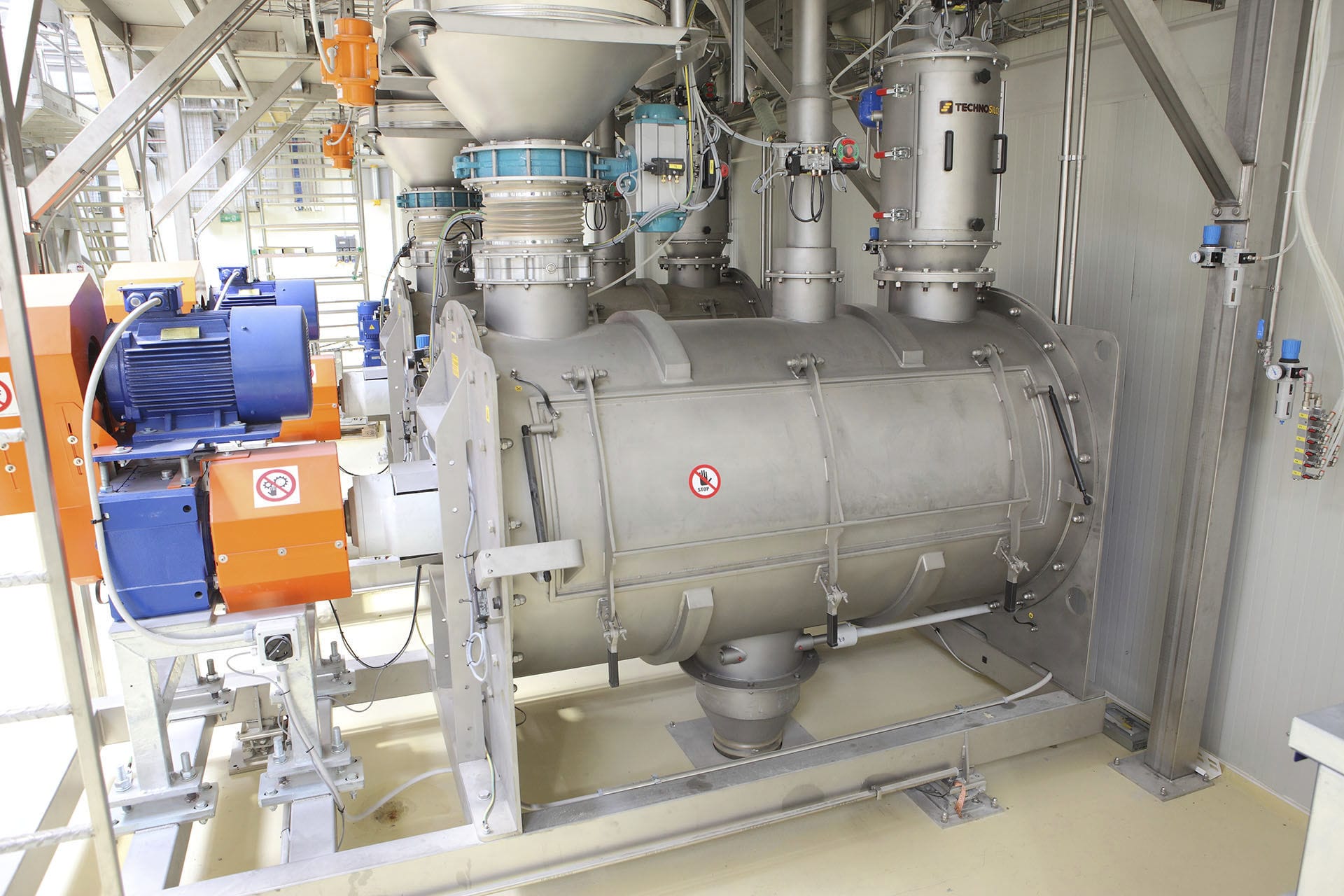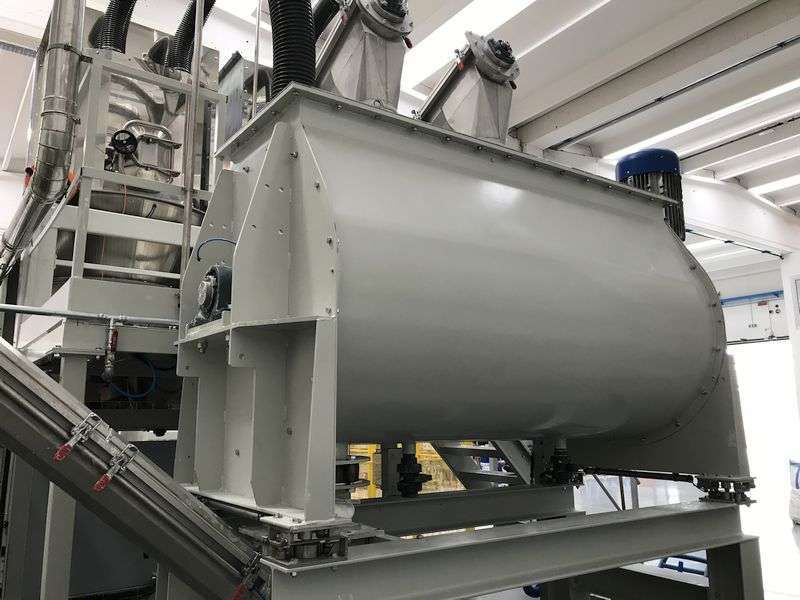







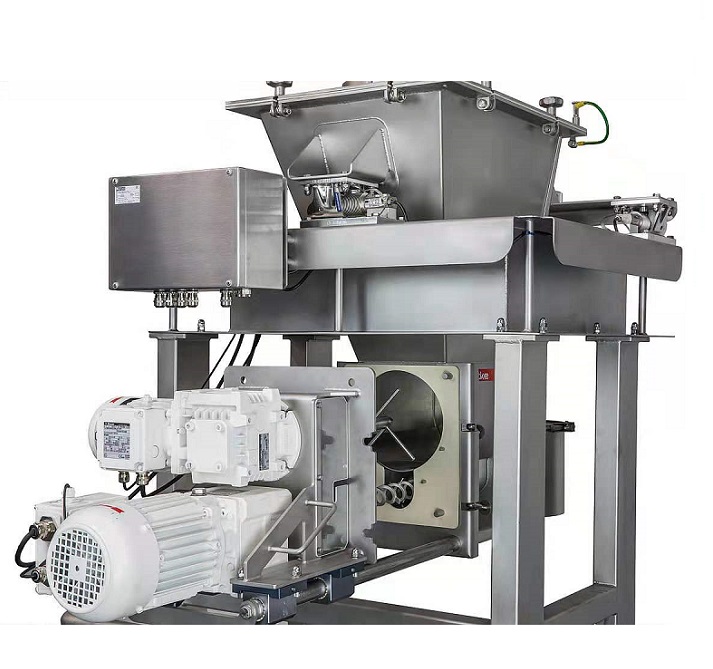
The screw metering mixer adopts a brand-new double auger screw blade centering design, achieving multi-directional circulation such as axial horizontal stirring and circular motion of materials. The mixing forms include various mixing processes. During the feed mixing process, the mixed feed, under the action of the spiral blades of the auger, moves forward in a spiral line from four directions at both ends of the feed box to the middle position of the mixer simultaneously. That is, while being conveyed horizontally in the axial direction, it is accompanied by rolling motion in the circular direction.

 020-34563445
The screw metering mixer mainly consists of two agitators, fixed knives, moving knives, a box body, a discharge port and a weighing device, etc. The auger (two augers arranged horizontally) is the main working component of the mixer. The motor transmits power through the auger shaft to drive the spiral sleeve to rotate. Spiral blades are welded on the spiral sleeve of the auger, and detachable star-shaped blades are installed on the spiral blades. Between the two agitators inside the material box, there is a crossbeam. Along the edge of the crossbeam, detachable fixed knives are evenly distributed. By the relative motion between the star-shaped blades and the fixed knives, a shearing surface is formed, thereby achieving the shearing processing of the material.
The screw metering mixer adopts a brand-new double auger screw blade centering design, achieving multi-directional circulation such as axial horizontal stirring and circular motion of materials. The mixing forms include various mixing processes. During the feed mixing process, the mixed feed, under the action of the spiral blades of the auger, moves forward in a spiral line from four directions at both ends of the feed box to the middle position of the mixer simultaneously. That is, while being conveyed horizontally in the axial direction, it is accompanied by rolling motion in the circular direction. Two counter-rotating screw shafts drive the two auger helical blades to rotate relatively, enabling the mixed feed to achieve a compound motion in both tangential and axial directions. The moving knives evenly distributed on the auger blades and the fixed knives installed between the two auger shafts move relatively to form a shearing surface, thereby shearing and rubbing the long grass. As the double-screw auger keeps rotating, the two ends of the auger in the material box move towards the middle section of the auger under the action of the spiral blades. When the material accumulates to a certain height in the middle section of the auger, a longitudinal drop is formed. The material's own weight overcomes the friction and cohesion force and falls freely, or slides down along the inner wall of the feed metering mixer, forming diffusion. The falling materials are mixed with the materials at the bottom of the feed box. The mixed materials roll in the axial direction to form a cross-mixing motion, achieving convection and extrusion of the mixed feed in the feed box. Thus, different materials with significant differences in particle size, mass and moisture content can fully slide and penetrate each other in the feed box. When the two auger shafts rotate simultaneously, the feed achieves a three-dimensional multi-cycle stirring movement in the three-dimensional space of the feed box. Under the continuous action of shearing, rubbing, diffusion and stirring, it is rapidly and evenly mixed, effectively preventing the formation of arches in the mixed feed, making the feed more fluffy and ensuring its palatability.
The discharge door control is composed of a hydraulic cylinder, a fixed support, a linked support and a sliding discharge baffle, etc. The discharge sliding baffle is installed on the reciprocating motion shaft of the hydraulic cylinder. The discharge baffle can be opened or closed at will through the control valve, and the feed discharge volume can be controlled by adjusting the size of the opening of the feed port. A high-strength magnetic plate is installed at the discharge port on the outside of the discharge baffle for iron removal tasks.
During the process of mixing and stirring materials, in order to achieve better mixing and stirring effects and save energy, it is required that the materials not be thrown up in a chain during the mixing and stirring process. Due to the influence of the rotating helical blades, the movement of the material is not merely a linear motion along the helical axis, but rather a spatial motion along the helical axis in a compound motion. The material is subjected to the frictional force between itself and the helical blades as well as the frictional force among the materials themselves. During the entire mixing and stirring process, when the screw speed exceeds a certain speed, the material will jump along the direction perpendicular to the axial due to excessive centrifugal force. The axial push will weaken, affecting the convection of the material and thereby reducing the uniformity of the material mixing. During the mixing process, no segregation should occur. The centrifugal force generated by the spiral blades of the auger acting on the materials should be less than the weight of the materials.