











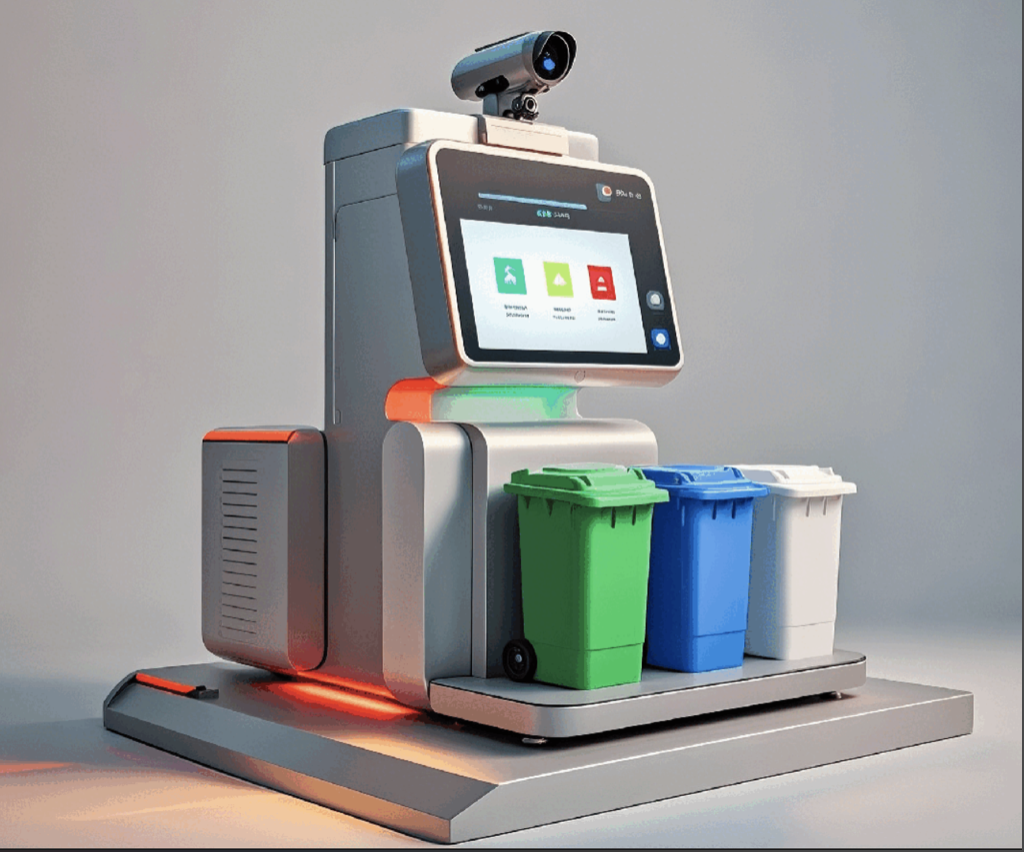
The garbage classification system acquires real-time data on the internal status of the trash cans. The ultrasonic sensor emits sound waves and calculates the reflection time to precisely measure the distance error between the garbage surface and the can lid, which can be controlled within +1 centimeter. The infrared sensor determines the height of the garbage pile based on the change in light intensity, and is suitable for non-transparent bucket environments. The weighing module is installed at the bottom of the bucket. The volume of the garbage is calculated based on the weight change. The optical sensor can identify the image features when the garbage overflows, and in combination with the edge computing device, visual judgment is achieved. Multi-sensor data fusion technology can integrate the advantages of various signals.

 020-34563445
Based on the current status of garbage classification and the development needs of trash cans, and in combination with the actual family scenarios, the overall scheme design of trash cans is carried out to determine the appearance style, size parameters, etc. Automatic control and automatic broadcasting are achieved by using embedded technology, machine vision technology, upper computer technology and voice broadcasting technology. Meanwhile, a classification mechanism is designed, and two servos are used to classify garbage into bins, solving problems such as residents' lack of classification awareness and inaccurate classification.
The intelligent garbage classification system takes a single-chip microcomputer as the control core to achieve coordinated control of various functional modules. Metal detection is achieved through metal sensors, and wet garbage detection is realized by using humidity sensors. The system defaults the garbage to dry waste. The sensor detects the relevant data and transmits it to the single-chip microcomputer. After the single-chip microcomputer processes the data, further identification of the garbage is achieved. When certain set conditions are met, the alarm automatically sounds, and the relevant information is displayed on the LCD screen. Ultrasonic distance measurement is installed on the lid of the trash can to monitor the garbage information inside at any time. An alarm will be triggered when the trash can is full. The overall hardware structure of the system mainly consists of a single-chip microcomputer control module, a display module, an alarm module, a sensor detection module, and a full-load detection module.
The intelligent garbage classification system mainly adopts liquid crystal display circuits. This liquid crystal display can show data of 16 characters in a single line or 8 characters in two lines. This display circuit can show various relevant data of garbage classification detection, specifically including garbage type information, trash can type information, full load information, and information of infrared weighing sensors, etc.
The humidity sensor is highly sensitive to environmental humidity and can be used to detect wet garbage. By adjusting the potentiometer, the value of humidity detection (control humidity value) can be changed. For example, when the environmental humidity needs to be controlled at 60%, the module will adjust to the corresponding environmental humidity until its green light is on, and the DO will output a low level. When the humidity is lower than this set value, it will output a high level and the green light will not be on. The DO output terminal can be directly connected to a single-chip microcomputer. The single-chip microcomputer is used to detect high and low levels, thereby detecting changes in environmental humidity.
When metal debris is detected, the field strength of the harmonic generated by the metal on the signal will change, causing a change in the current around the magnetic field and thus forming eddy currents. When the probe coil comes into contact with the eddy current impedance, the impedance will change, thereby altering the amplitude of the metal detector. This amplitude variation is used as a detection signal, which is amplified and transformed into an audio signal to drive the buzzer to sound an alarm.
The working circuit consists of two parts: the low-voltage control circuit and the high-voltage working circuit. When the key is pressed, a low voltage is applied across the electromagnet, causing the electromagnet to start working and pull down the armature, thus disconnecting the working circuit. As a result, the key electromagnet loses its magnetic force and releases. The armature relay only needs to control the low-voltage circuit to achieve control of the high-voltage circuit.
Real-time data on the internal status of trash cans is obtained by multiple types of sensors. The ultrasonic sensor emits sound waves and calculates the reflection time to precisely measure the distance error between the garbage surface and the bucket lid, which can be controlled within +1 centimeter. The infrared sensor, on the other hand, determines the height of garbage accumulation based on changes in light intensity and is suitable for non-transparent bucket environments. The weighing module is installed at the bottom of the bucket. The volume of the garbage is calculated based on the weight change, but the error problem caused by the difference in garbage density needs to be solved. In addition, optical sensors can identify the image features when garbage overflows, and in combination with edge computing devices, they can achieve visual judgment. Multi-sensor data fusion technology can integrate the advantages of various signals and increase the detection accuracy to over 98%.


