








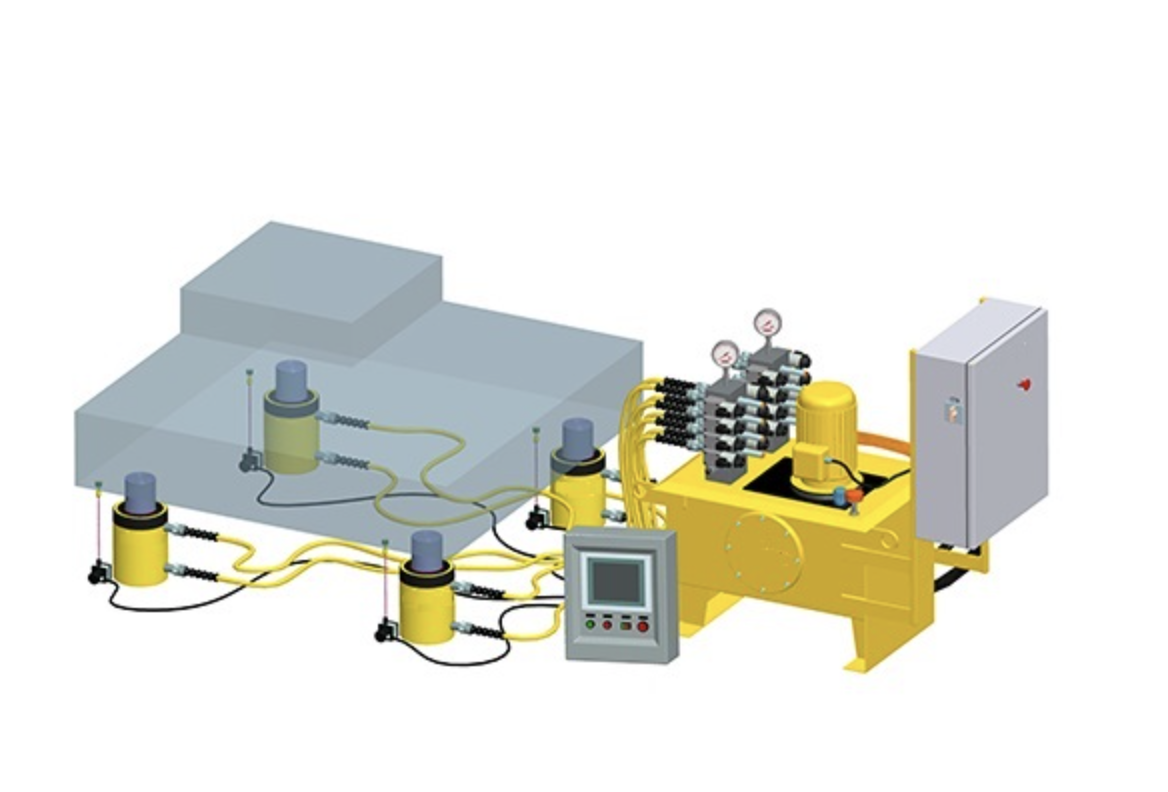
The calibration device of the hopper scale adopts the dual-pump linkage control technology of the hydraulic control system. It uses two sets of servo drive units. One set controls the oil supply of the mechanism, consisting of an oil pump, a motor, and a motor drive unit. The motor is connected to the oil pump, and the motor drive unit is connected to the motor. The motor drive unit is connected to the data acquisition and control system. The other set is responsible for the oil discharge of the mechanism. Each module and the oil inlet end of the servo drive unit are similar. The control system can simultaneously collect the feedback signals of four standard load measurement units and control the loading and unloading of the standard load through the control software on the computer end.

 020-34563445
The calibration device for the hopper scale enables full-scale calibration. The weighing load measurement instrument method uses a standard load measurement unit composed of a weighing force sensor and a hydraulic cylinder, and an intelligent hydraulic control system as the load power source. The standard load is applied to the hopper scale through an anti-reaction auxiliary device, thereby achieving the verification method for the溯源 of the scale's measurement value. According to the principle of the superimposed comparison type force measuring machine, the load is equally transmitted to the weighing module of the on-site calibrated hopper scale and the weighing force sensor through different methods. The weight displayed on the supporting instrument of the weighing force sensor is the weight loaded by the weighing module of the calibrated hopper scale. This is used for on-site calibration of the hopper scale. The standard load measurement unit composed of the hydraulic cylinder and the weighing force sensor forms the load power source. High-precision hydraulic is used as the load power source to lift the cylinder, and the load is loaded to the龙门式反力 frame through the standard load measurement unit. According to the principle of reaction force, the standard load measurement unit applies the standard load to the bearing plate of the hopper scale at the bottom, thereby achieving the loading of the standard load for the hopper scale. Finally, by comparing the readings of the hopper scale and the calibration device, the metrological performance of the scale is evaluated.
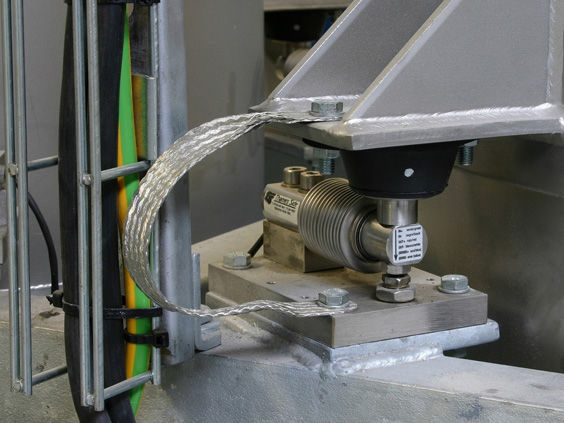
The hopper scale is usually composed of four Weighing modules. The calibration device is arranged above each of the four weighing modules, and the device is composed of龙门式反力 frame, weighing force sensor, hydraulic cylinder, embedded connecting rods, etc. Before installing the calibration device for the hopper scale, the support columns of the four weighing modules need to be modified. The support columns above the weighing modules are welded with a bearing plate, and the corresponding position below the bearing plate is installed with an embedded connecting rod for installing the龙门式反力 frame. The hopper scale mainly consists of a storage hopper, limit device, lifting mechanism, Weighing system, and electrical control system. The calibration device includes a jack, weighing force sensor, distributor, and high-pressure oil pump, weighing support plate, lower base plate, weighing module, and the calibration device includes the weighing force sensor and the calibrated weighing module, and the parallel weighing display. The first calibration weighing module and the second calibration weighing module are electrically connected to the junction box. Through the combination of the first calibration weighing module and the hydraulic jack, the traditional method of using weights for calibration is time-consuming and labor-intensive, while other calibration methods often fail to ensure accuracy and data traceability. The reverse force method of the jack weighing calibration instrument provides an economical and convenient calibration method, which is traceable and avoids cumbersome or expensive operations such as carrying weights or using purified water. At the same time, it eliminates the risk of cross-contamination of the hopper. The calibration force value generated by the hydraulic cylinder is measured by the high-precision reference weighing module, and the calibration of this sensor can be traced back to the weight standard. This process pushes the hopper scale upwards, achieving the same effect as normal weighing, thus naturally resolving the pipeline impact.
The weighing calibration instrument of the hopper scale adopts the dual-pump linkage control technology of the hydraulic control system and uses two sets of servo drive units. One set controls the oil inlet of the mechanism, which consists of an oil pump, motor, and motor drive. The motor is connected to the oil pump, and the motor driver is connected to the motor. The motor driver is connected to the data acquisition and control system; the other set is responsible for the oil outlet of the mechanism, and each module and the oil inlet end of the servo drive unit are similar. The control system can simultaneously collect the feedback signals of the four standard load measurement units and control the loading and unloading of the standard load through the control software on the computer end.


